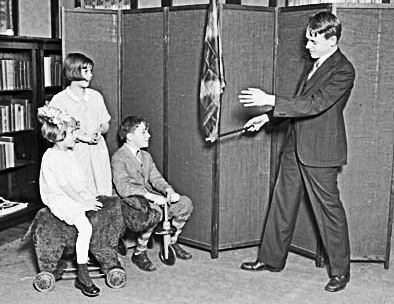
 “Our focus is sharp, but our light faded,” so wrote the famous, or perhaps infamous scientist and magician Derek Livingston in 1965. The man commonly associated with the dangers of quack-science or a magician’s claims of super-natural powers, was born on this day in 1936.
Dr. Livingston’s phrase had many possible meanings but all were tied to his confusion of magic and science.
Dr. Livingston’s fame and infamy arise from the same experiments in the late 1950s and 1960s with laser technology (Light Amplification by Stimulated Emission of Radiation) as well as his life-long love for magic.
Dr. Livingston worked his way through the distinguished and ivy-draped halls of the country’s finest schools. He was not from a wealthy family or noble ancestry but relied upon the kindness of others for his housing, food and supplies. In 1955, the then Mr. Livingston, took up work at the prestigious Bell
Labs whilst he considered the question of light’s structure. Was light made up of waves or particles?
He supplemented his income by performing magic shows for co-workers and their families in Murray Hill, New Jersey. He was known for his deft sleight-of-hand and charisma. His show was billed as “lasts 20 minutes, more than an hour’s worth of magic, you’ll remember for a lifetime.”
It was an old question. Prior to Sir Isaac Newton’s corpuscular theory, light was thought to be made up of particles. Newton demonstrated his wave theory by showing light could be reflected and refracted with mirrors and prisms.
So great was Newton’s legend that none dared to challenge his theory until early in the 1800s. Light is made up of waves, suggested some scientists. Their proof? When light is split into apparent constituent parts, it can be made to interfere with itself.
Just as waves going in one direction can be “cancelled out” by the same size waves going the opposite direction, light properly cast on itself could cause the lack of light.
Einstein postulated that as later proven by breath mint technology, light can be made up of two things at once. Light is a wave when one is looking to test its wave properties but exhibits particle characteristics when testing for particles.
This postulation gave support for quantum mechanics and our modern understanding of light, particle physics, and even scientific inquiry.
But back to Dr. Livingston. The good doctor studied light and its properties with the single-minded determination of a man possessed. He was particularly excited (pun intended) by the new field of lasers. In 1958, two Bell Labs scientists released a paper demonstrating that it was possible to build a functioning laser. (Physical Review v. 112, issue 6, “Infrared and Optical Masers,” A. L. Schawlow and C. H. Townes, Bell Telephone Laboratories).
Dr. Livingston’s loyalty for Bell Labs was evidenced in his public support for their patent application over the later-vindicated claims of Dr. Gordon Gould of Columbia University. (Dr. Gould challenged Bell Labs’ patent claims. It took 20 years, but he was finally awarded the patent rights for their patent application over the later-vindicated claims of Dr. Gordon Gould of Columbia University. (Dr. Gould challenged Bell Labs’ patent claims. It took 20 years, but he was finally awarded the patent rights – see article in “MIT Inventor of the Week,” January 1998; List of Dr. Gould’s patents related to the laser from 1975 forward here). He spent his own funds to advertise support for Bell Labs’ position.
But back to the connection with magic.
Dr. Livingston struggled to find a way to incorporate his obsession with the nature of light, love of the new laser technology, and magic. He initially offered a public lecture for civic groups and schools where he discussed the newest laser/maser technology and used magic to enhance the demonstration. A
laser in 1965 weighed over 22 pounds and required an enormous power source.After months of lugging the “portable laser” from lecture to lecture, Dr. Livingston decided to replace the real thing with a light-weight prop and use magic techniques to duplicate the effects of the laser beam.
The lecture was a hit and his aching back recovered from its painful and repeated insult. When demonstrating the real laser, Dr. Livingston would demonstrate its awesome and precise power by igniting paper held by a spectator, lighting a cigarette in the mouth of another spectator (without burning the volunteer’s face or lips), carve the host’s name into plywood, and measure the
distance of any moving object (without harming the object).
Using magic methods, he was able to duplicate these effects but instead of a high-powered laser, he needed only a pen-light encased in a plastic “gun” device. Dr. Livingston never viewed his demonstrations as fraudulent but he also never advised his audience the effects were caused by magic tricks rather than laser science.
There are many articles written about Dr. Livingston’s arrest and conviction following the New York World’s Fair and this essay will not repeat those sordid details here. What has not been covered previously, is the psychological and emotional trauma Dr. Livingston suffered in the days prior to his arrest on the fair grounds.
Dr. Livingston’s understanding of laser technology was capped when he left the research field and entered into entertainment. At the time of his arrest and the alleged “Mass Laser Burns,” Dr. Livingston had no idea how far laser technology had progressed since 1960. He still carried his “laser gun” and magic show, and still carried on his charade of demonstrating the effective power of the space-age technology.
As an adjunct to one of the corporate pavilion set-ups, Dr. Livingston offered 12 demonstrations a day to interested laymen from around the world. It is remarkable he was not challenged by a scientist during the first few months of his appearance at the World’s Fair.
Dr. Livingston’s repertoire had grown from lighting, burning, and measuring things with the “laser gun” to effecting miraculous cures and changing the very essence of items.
Using a slightly modified Dove Pan trick, he was able to light a fire in the pan, extinguish the fire by covering it, and producing a live rabbit from the pan. With the help of a modified Bengal Net trick, he demonstrated the ability of the laser to “vaporize” anything in its beam. The previously produced rabbit was loaded into the net, the beam was fired at the bunny, the net dropped open and the bunny had vanished.
He also used the laser beam to help cut and restore rope, open and immediately and seamlessly fuse steel rings (ala Chinese Linking Rings), bring an apparently dead pigeon and rabbit back to life (using the well-known “animal hypnotism techniques”), and finally to read the thoughts of spectators.
It was this last effect that brought him much attention and ultimately tragedy.
Modern psychics have considered Dr. Livingston’s methods for mind-reading. They uniformly agree the techniques were basic (essentially center-tear and one-ahead) but the presentation was breath-taking.
On July 2nd 1965, Dr. Livingston was confronted with a choice whether to reveal his magic secrets or affirmatively commit fraud. He chose the latter and paid dearly.
The following is taken from reports in the local newspapers of the day as well as police investigation reports:
Dr. Livingston began his demonstration the way he always began. He gave a short description of the “concentrated and focused” power of laser light beams.
With the flash of a beam from his “laser gun” he started a small fire in the dove pan and produced the rabbit. So far, so good.
In the next portion of the lecture, Dr. Livingston would show the laser’s enormous potential for weapon technology by making the bunny vanish in a puff of vaporized smoke. Witnesses said they could actually smell what they thought was an animal burning. These reports are likely evidence of the power of suggestion. There is nothing to indicate the rabbit was hurt in any manner.
The last portion of the lecture offered spectators a “glimpse into tomorrow’s laser.” It was at this point that the bunny (possibly the same one from the Bengal Net but there is no record of this) and pigeon were “killed” by the beam and then then brought back to life with a different hued beam.
The response to this section was always strong but on this sweltering July day, the reaction was near hysteria. The following from a witness as captured in the police report:
“Then he made the rabbit come alive and the rabbit seemed to be fine and breathing. We were all amazed and started to applaud like we have (sic) just seen a magic trick or a miracle. A lady near me said something I didn’t hear but it was loud enough to hear over the clapping. She pushed through the crowd up to the stage, up front and told him she had some tumor or something he needed to kill with the laser gun. He said he wouldn’t use it for that purpose because it was unethical.”
From another witness, we know the crowd encouraged Dr. Livingston to carry through with the ad-hoc surgery.
“We all yelled, ‘help her!’ And he kept saying ‘No, No!’ Another lady came up and said she had a growth in her that was causing her to bleed and he needed to help her too. He kept saying ‘No, No!’ and was trying to get off the stage towards the fire exit on the right.
“The first lady jumped up to the stage and went to grab the gun from him to shoot it herself, I think. He was fighting her to see who could hold it and was trying to keep it from going off or hurt anyone. But she was real strong and angry and she got the gun away from him and pointed it at her stomach or around there and shot herself with it for a long time ’til he got it back.
“We all smelled the same smell that we smelled when the rabbit got lasered the first time so we thought something went wrong or that she was hurt from it. The lady let go of his arms and fell on the stage and hit her head on the table on the way down. She was knocked out but I didn’t know if she was knocked out from the head hit or the laser beam.”
We do know from press reports that the first woman was unconscious for much of the ensuing activity and did not regain consciousness until she arrived at the medical pavilion a half-hour later. The second woman took advantage of the first woman’s fall to take the laser gun from Dr. Livingston and she too used it on herself. There was a similar odor produced and she fell unconscious to the stage but was quickly revived.
More audience members came forward and stormed the stage demanding they be healed. Dr. Livingston said later he must have been caught up in the hysteria to do what he did next.
As the crowd approached, Dr. Livingston pointed the “laser gun” at the first few spectators and told them to stand back or he would “vaporize them.” The crowd stopped and some jumped off the stage to flee. A few men and women remained but did not progress further. There was an eerie silence as three women and two men faced Dr. Livingston. The doctor and the five audience members were about ten feet apart. The two unconscious women were in a heap between the opposing sides.
Dr. Livingston said in court documents later that the moment felt like “the old west, like the quiet before the shoot-out at the OK Corral.” One of the women took a step forward and Dr. Livingston pointed the gun towards her and “fired.”
The same odor was produced, and the woman dropped to the stage. Dr. Livingston the fired the gun at the remaining four on stage and one-by-one, they fell to the stage amidst the smell of vaporized matter.
Before a second wave of the mob could attack, Dr. Livingston tried to escape through a curtain at the back of the stage but was apprehended by New York police.
Later forensic examination of the “laser gun” proved it was nothing more than the pen-light with a connection to the trigger of a plastic gun body. Experts for both the prosecution and defense agreed the gun could not have injured any of the victims and that their reaction was purely a function of their hysteria.
“It was similar to mass hypnosis. They believed so fervently this gun was real, they fainted from ‘being shot.'”
Dr. Livingston wrote a portion of his attorney’s closing argument; including his now famous defense “Our focus is sharp, but our light faded.” Some wondered if he was making a philosophical point, giving an assessment of his legal defense, or just trying to explain his defense.
Although Dr. Livingston was convicted on seven of the eight counts, those seven charges were misdemeanors relating to fraud in shows or exhibitions. The eight count was essentially a battery charge and the court dismissed the charge after hearing the evidence. Under the law, a battery consists of the “unwanted touching or striking of one person by another, with the intention of bringing about a harmful or offensive contact.” The court ruled the gun could not have caused harm to the victims and there could not have been a battery.
The lawyer in us wonders why the prosecutor did not charge Dr. Livingston with assault rather than or in conjunction with the battery count. Assault does not require a physical touching or striking but only an act that causes a victim to believe he or she will be injured, a threat of physical harm. Perhaps the New York Criminal Code in 1965 included the language found in some versions of assault requiring the attacker to have the physical ability or the means to carry out the threat.
Dr. Livingston served just two months in the city jail for his offenses. His victims recovered from their “laser burns” on the day of the incident. Sadly, the first woman on stage, later died believing she had been cured by the laser beam. She was struck by a streetcar six weeks later while returning from a “celebration of her cure.” The autopsy found no evidence of any tumor within her body.
There is no documentation that a physician ever told her she was dying of a cancerous tumor and some have speculated her belief was unfounded but seemed as real to her as the “laser gun.” There are a few commentators who suggest she did indeed have a tumor and either by miracle or placebo was “cured” by the soft glow of a pen-light.
Dr. Livingston traveled to Europe for a few years after his release and gave a new lecture about the power of suggestion and the danger of charlatans. He returned to the United States in 1972 and gave an updated version of the same lecture for the next five or six years before settling down in Bisbee, Arizona — just south of Tombstone, the site of the shoot-out at the OK Corral — an event he referenced in describing the “laser burn” incident.
Dr. Livingston never married and had no close friends or family. He was a prolific author of magic books and tricks under various pseudonyms. Some of his effects can still be seen in stage shows performed in Las Vegas. Because he did not publish under his real name, few magicians ever linked the inventor of so many unique effects with the events of July 2nd 1965. Dr. Livingston wrote that he had received enough publicity in his life and preferred living outside the limelight.
He ultimately passed away in his sleep on June 11th, 2000. A slightly corroded penlight was found under his pillow.
Related Posts
Houdini’s Limit on Google

We love the world’s best known magician, Houdini. We also take great pride in our programming abilities and yet we…
Houdini: A Case Study in Trauma

The May 21, 2009 on-line edition of the journal Advance for LPNs features Cynthia Blank Reid captivating review of the…
What Goes Into Inventing a New Magic Trick?

What goes into inventing a magic trick?
That’s a question we are trying to answer as we develop, possibly for sale, an effect that could be popular with close-up magicians. Because that’s what we do, close-up magic, it seemed natural to make commercial offerings of the tricks we do for audiences in the amateur rooms at The Magic Castle.
Zoom Magic Sought by Inside Magic

We have seen some wonderful Zoom magic shows recently. We realized we only knew about them because friends (we’re not…
Inside Magic Review: David Copperfield’s History of Magic

We have been a fan of David Copperfield since his early days. We anticipated his television specials with the same…
